
Living with a pacemaker or ICD
1) Big picture
Most people with a pacemaker or ICD can lead a normal, active life. The device treats slow heart rhythms (pacemaker) or protects against dangerous fast rhythms (ICD). With a few habits—good wound care, staying connected to remote monitoring, sensible precautions around strong electromagnetic fields (EMI), and clarity about MRI and driving—patients can travel, work, exercise, and enjoy family life. Major societies also now consider remote monitoring (RM) the standard of care and stress the importance of reliable connectivity and patient education. (2023 HRS/EHRA/APHRS/LAHRS Expert Consensus Statement on Practical Management of the Remote Device Clinic)
2) Early recovery & wound care
- Incision care (first 2–4 weeks): keep the site clean and dry as directed; avoid soaking the wound; report redness, increasing pain, discharge, fever, or device erosion urgently (infection risk). Consider this UK patient leaflets which emphasises prompt contact if swelling/redness appears (PDF).
- Arm movement: while normal arm movement is allowed and may even prevent “frozen shoulder syndrome”, avoid extreme or repetitive overhead motions on the implant side until cleared.
- Driving right after implantation: see the country table below—restrictions vary.
3) Remote monitoring
- Set-up before discharge and verify at first follow-up.
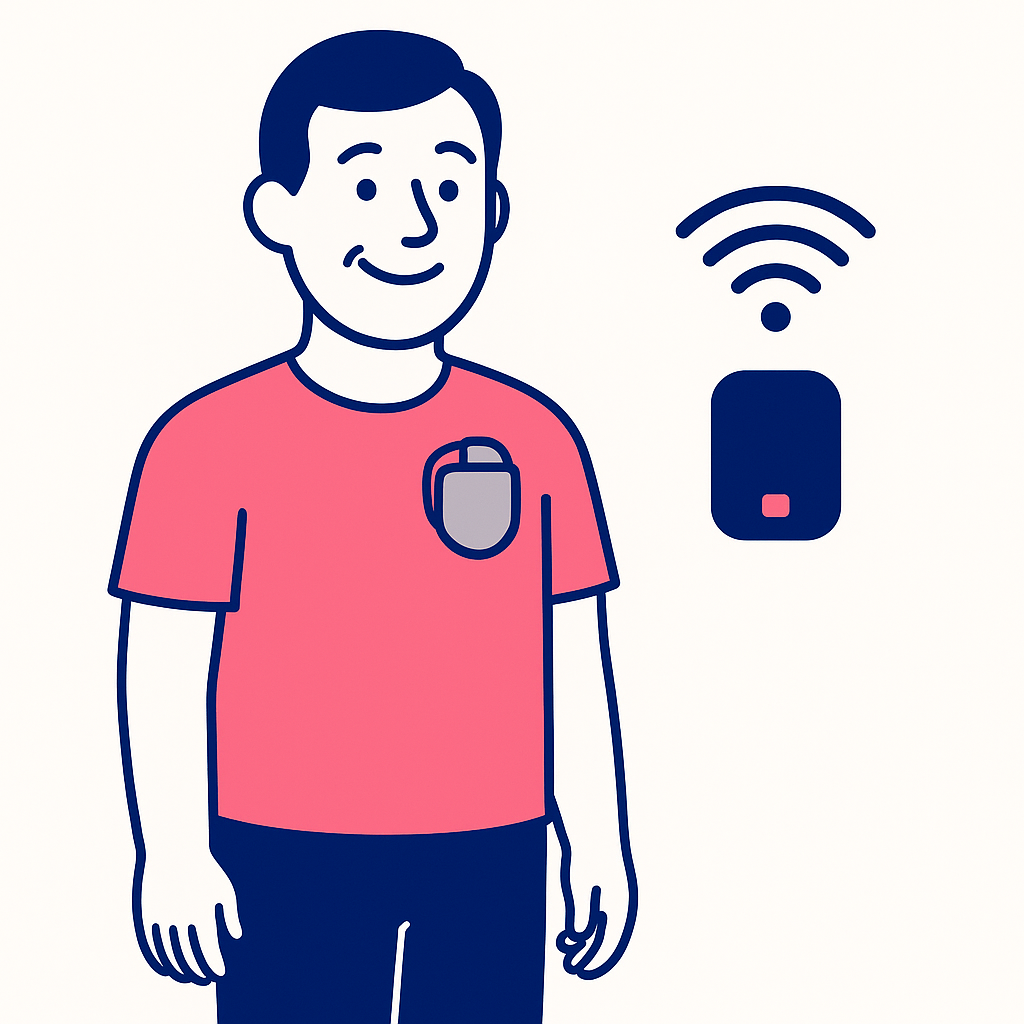
- At home: keep the transmitter within the recommended distance (within the same room as the patient sleeps), plugged in.
- Travel ≥2–3 weeks: take the transmitter (or confirm mobile app works abroad) and check power plug/adapters. If traveling off-grid, inform the device clinic beforehand. RM improves safety and workflow and is the recommended standard.
4) Everyday tech & electromagnetic interference (EMI)
Generally safe: microwaves, induction hobs used normally, household appliances in good repair, smartphones kept ≥15 cm from the device (don’t carry in shirt pocket over the implant), walking through shop anti-theft gates and airport metal detectors at a normal pace without lingering. Large societies and patient resources note security systems/body scanners are low-risk; don’t lean on them and show your device card if asked.
Be extra careful or get advice first:
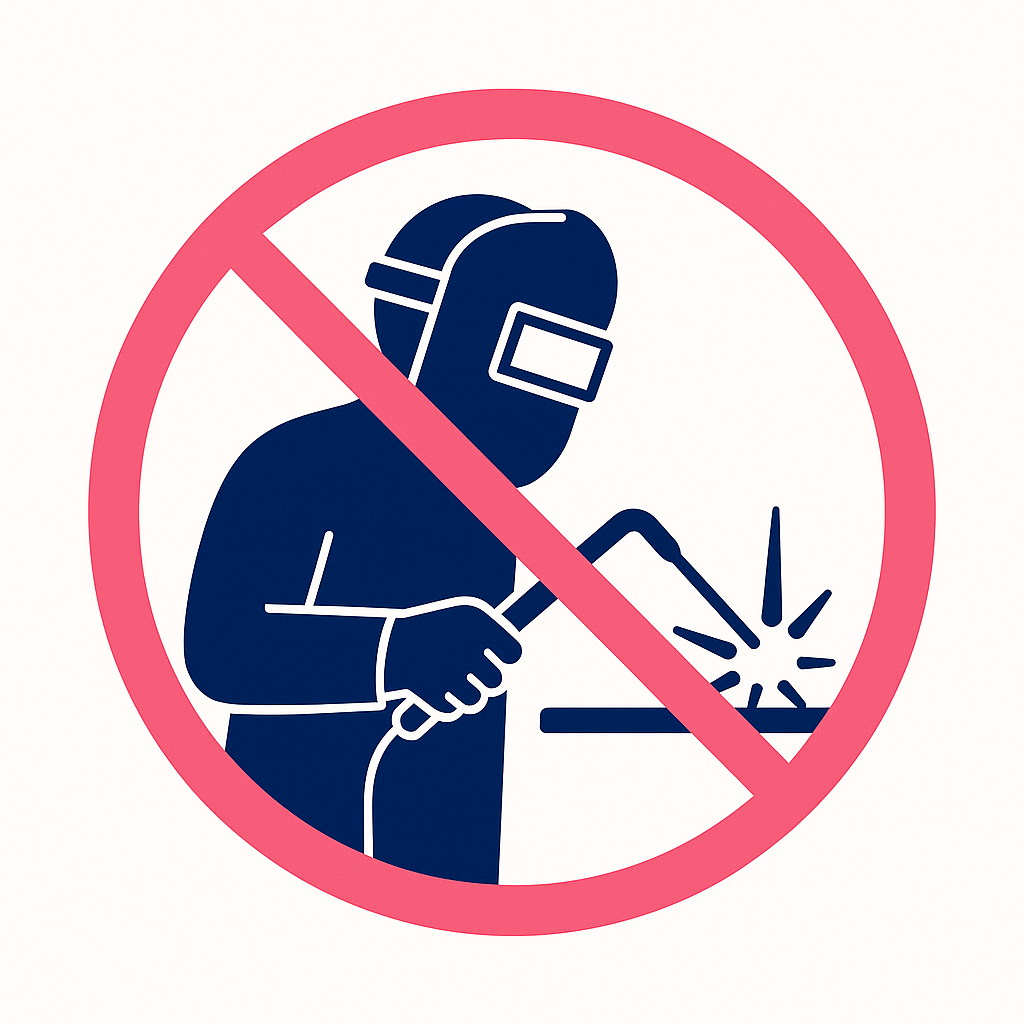
- Welding: can create strong magnetic/electric fields. Patients are generally instructed to avoid welding as it can be associated with inappropriate inhibition of pacemaker and inappropriate therapies by ICDs. If a patient must weld, many manufacturers advise keeping the welding arc ≥60 cm from the device, the power unit ≈1.5 m away, and limiting current to <160 A, with good insulation and cables kept together/away from the chest. Discuss with the device team beforehand.
- High-power magnets & industrial equipment: avoid placing strong magnets near the device; ask the clinic before working around induction furnaces, large motors, or RF transmitters. European consensus documents cover procedural/medical EMI in depth (EHRA consensus statement).
Airports & travel: It’s fine to fly. Inform airport personelle that you are carrier of a PM/ICDs, they will probably propose to skip the portal and do a manual check. If a handheld wand is used, ask security not to hold it over the device. Carry the device ID card. (www.heart.org)
5) MRI, CT, radiotherapy & procedures
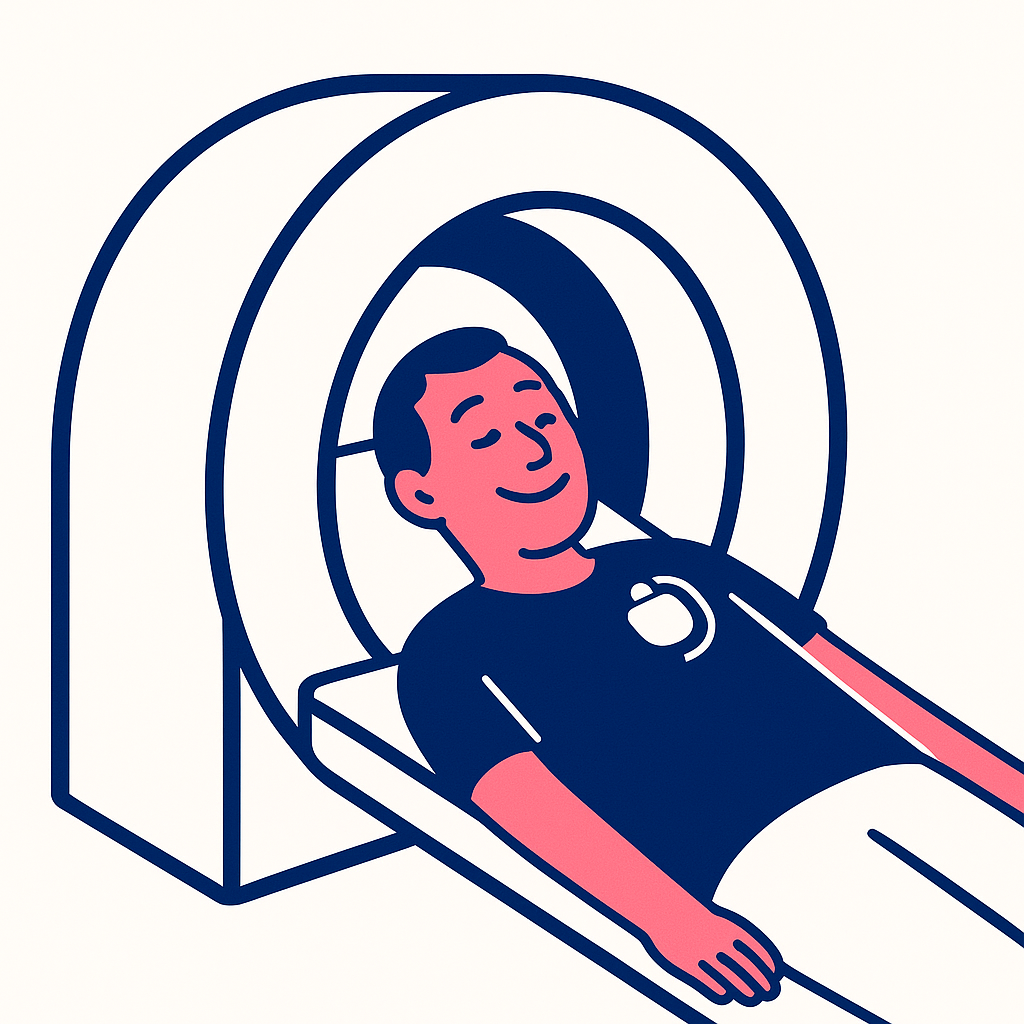
MRI: Today, most patients with pacemakers/ICDs can undergo MRI safely when appropriate protocols and monitoring are used—even with “non-MRI-conditional” systems. Abandoned, fractured or epicardial leads are higher-risk but can still be scanned in expert centers under strict protocols. Always inform the imaging department and your device clinic; they must coordinate device checks/mode changes and on-site monitoring. (Questions and Answers in MRI)
CT, X-ray, ultrasound: generally safe.
Radiotherapy & electrosurgery: require a plan with oncology/anesthesia and the device team (field strength, beam path, magnet use or reprogramming). Follow EHRA consensus steps to avoid EMI (EHRA).
6) Exercise, work & sport
- Exercise is encouraged unless the underlying cardiac condition dictates limits. Build up gradually after wound healing; avoid direct blows to the device pocket (contact sports may need padding or avoidance).
- Pacemakers/ICDs adapt to activity, and rate-response can be tuned if patients feel under-paced during exertion.
- Occupational considerations: jobs around heavy EMI (industrial welding, large generators) require individualized advice (see EMI above).
7) Driving restrictions (private vs professional)
Rules change and differ by country, device type, and indication (primary vs secondary prevention for ICD), and after any ICD therapy. The table summarizes typical minimums for Group 1 (private car/motorcycle) after an uncomplicated new implant and headline rules for Group 2 (commercial/heavy vehicles). Always confirm locally (links cited).
| Country | Pacemaker – private driving (after new implant) | ICD – primary prevention (no prior sustained VT/VF) | ICD – secondary prevention (after sustained VT/VF or cardiac arrest) | Professional/Group 2 (bus/lorry/heavy) |
|---|---|---|---|---|
| France | Common practice: brief restriction after uncomplicated implant; medical fitness per Arrêté 28 Mar 2022; patient must attend medical commission if requested. | Often ~4 weeks (European practice), physician assessment. | Often ~3 months off; longer if shocks/syncope; physician/commission decision. | ICD generally incompatible with Group 2 licensing under updated rules. (Légifrance) |
| United Kingdom (DVLA) | 1 week off (Group 1); 6 weeks off for Group 2; notify DVLA for new pacemaker. (GOV.UK) | 1 month off is typical if purely preventive; notify rules vary by scenario (DVLA guidance/leaflets). (Chelsea Westminster Hospital) | ≈6 months off is typical; further bans after appropriate shocks; must notify DVLA. (GOV.UK) | Many ICD cases are not eligible for Group 2. (GOV.UK) |
| Spain (DGT framework) | Allowed after medical report; license validity may be shortened; typical waiting ~4–6 weeks post-implant per BOE criteria. (BOE) | Permitted with favorable cardiology report; validity period reduced. (BOE) | Permitted case-by-case with specialist report; practical restrictions commonly 1–3 months+ depending on events. (BOE) | Professional licenses are more restrictive; case-by-case, often not permitted with ICD. (BOE) |
| Portugal (IMT) | Group 1 generally permitted after effective treatment & favorable medical assessment; timeframe set by physician. (Diário da República) | Allowed for Group 1 with medical clearance; timeframe individualized. (Diário da República) | Allowed only with favorable medical assessment; typical European practice 3–6 months after index event. (Diário da República) | ICD listed as disqualifying for Group 2 (heavy/commercial), except rare exceptions after medical board review. (Diário da República) |
| USA | No single federal rule for private drivers; common practice: ~1 week after pacemaker. (American College of Cardiology) | Primary prevention: many experts allow ~1 week once wounds heal and no events. (American College of Cardiology) | Secondary prevention: commonly ~6 months off; shorter (e.g., 3 months) is supported by newer data in selected patients; after appropriate shock, restrictions usually re-start. Commercial interstate CMV licensing is restricted by FMCSA. (AHA Journals) | |
| China |
Medical fitness is required at licensing; national English-language guidance specific to CIEDs is limited. Private driving generally requires passing medical checks; local authorities may vary. (english.bjsjs.gov.cn) |
As left (medical assessment); seek written clearance from hospital if requested. | As left; after shocks or syncope, expect temporary suspension until reassessed. | Commercial/large vehicle licenses have stricter medical standards and age limits; CIED carriers may face disqualification depending on local rules. (english.bjsjs.gov.cn) |
How to use this table: treat it as orientation. For any individual patient, the underlying cardiac condition, any recent arrhythmia/shock, and local legal requirements determine the final answer.
8) National patient organizations (share with patients)
- France: APODEC – Association des Porteurs de Dispositifs Électriques Cardiaques (pacemaker & ICD patient association). (AssoConnect)
- United Kingdom: Arrhythmia Alliance (patient booklets on pacemakers/ICDs). (heartrhythmalliance.org)
- Spain: Sociedad Española de Cardiología – patient pages (Fundación Española del Corazón—marcapasos information). (fundaciondelcorazon.com)
- Portugal: LAHRS (Portuguese page on remote monitoring) and national emergency institute resources for patient education. (lahrs.org)
- USA: Mended Hearts (peer-to-peer support nationwide). (Mended Hearts)
9) Workup cards for allied professionals (use during counseling)
A) Quick MRI checklist
- Confirm system type (MR-conditional/non-conditional; any abandoned/fractured/epicardial leads?). Verify the Magnetic Resonance Imaging (MRI) compatibility of implanted MicroPort CRM device here:
- Notify cardiology/device clinic and MRI team; agree on pre-scan programming, monitoring and post-scan interrogation.
- Prefer 1.5 T when possible for higher-risk scenarios; follow consensus safety and sequence recommendations. (Questions and Answers in MRI)
B) EMI “green/yellow/red”
- Green (OK): phones, earbuds, microwaves, Wi-Fi, household tools used normally.
- Yellow (ask clinic): arc welding, industrial motors, magnetic therapy mats. (Medtronic)
- Red (avoid placing close to device): strong magnets (e.g., big speaker magnets, modern smartphones such as Iphone 12 and later) directly over the chest.
C) Travel
- Bring device ID card + medication list.
- Take remote monitor (or confirm app works) for trips >2–3 weeks and international travel.
- Airports: alert airport staff that you are implanted with a pacemaker of ICD before walking through detectors; don’t linger or lean; ask handheld wands not to hover over the device. (www.heart.org)
D) Exercise return
- Light walking immediately if safe; progress over weeks.
- Avoid heavy contact on the pocket; consider chest protector if resuming contact sports.
10) Frequently asked questions
Can I use an induction stove or microwave? Yes, used normally. Don’t press the device directly on the cooktop edge. (www.heart.org)
Can I weld? Preferably avoid. If necessary, keep currents <160 A, arc ≥60 cm from the device, the power unit ~1.5 m away, cables together/away from chest, and wear dry insulated gear—and get device-team clearance first. (Medtronic)
I’m due an MRI. Is it allowed? Often yes—with the right team and protocol. Inform radiology and your device clinic early; some situations (e.g., abandoned/fractured leads) need expert-center protocols. (Questions and Answers in MRI)
Will shop gates or airport scanners stop my device? No—don’t lean or linger; walk through normally. (www.heart.org)
Do I need to tell authorities about my device for driving? In many countries you must notify (e.g., UK DVLA) and observe a temporary ban after implant or after ICD shocks. Always check the local rule. (GOV.UK)
11) Key references for healthcare professionals
- Remote monitoring standard: 2023 HRS/EHRA/APHRS/LAHRS Expert Consensus. (OUP Academic)
- MRI with CIEDs: 2024 SCMR Expert Consensus & ACC review. (Questions and Answers in MRI)
- EMI (medical procedures): 2022 EHRA consensus. (PMC)
- Driving (general evidence): contemporary reviews and jurisdictional rules. (Air Unimi)
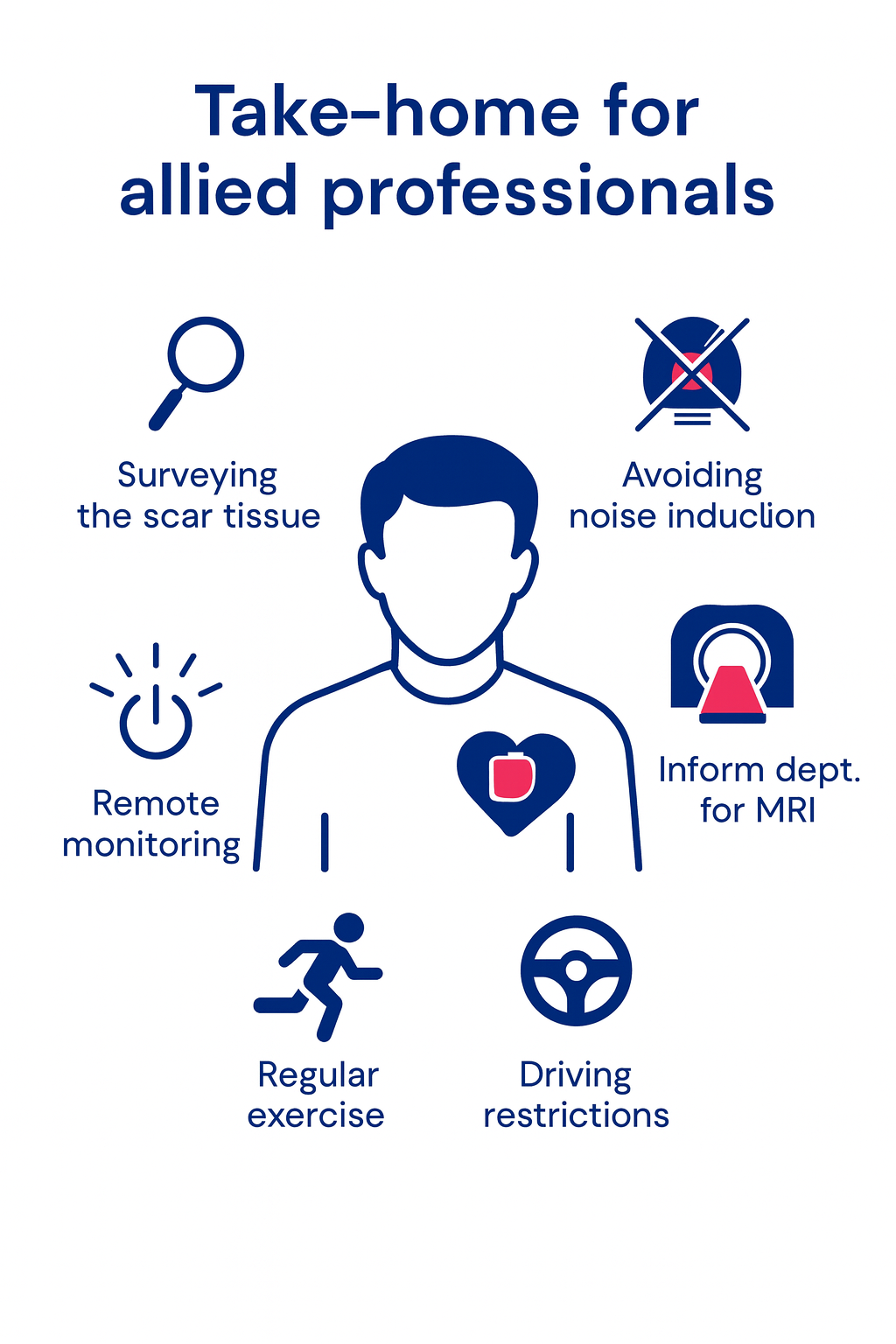
Take-home for allied professionals
- Reassure: normal life is the default—with smart precautions.
- Guard the wound early on; teach infection red flags.
- Remote monitoring must be connected and travel-ready.
- EMI: routine tech is fine; welding/industrial exposure needs planning.
- MRI is increasingly feasible—coordinate early with radiology/device teams.
- Driving is country-specific—know local rules; reassess after any ICD therapy.